
«Prev From Oct 21, '26 to Nov 20, '26 Next»
10208
So Heddan So Hoddan
Thu Jan 22, 7:00 PM
Lamakaan
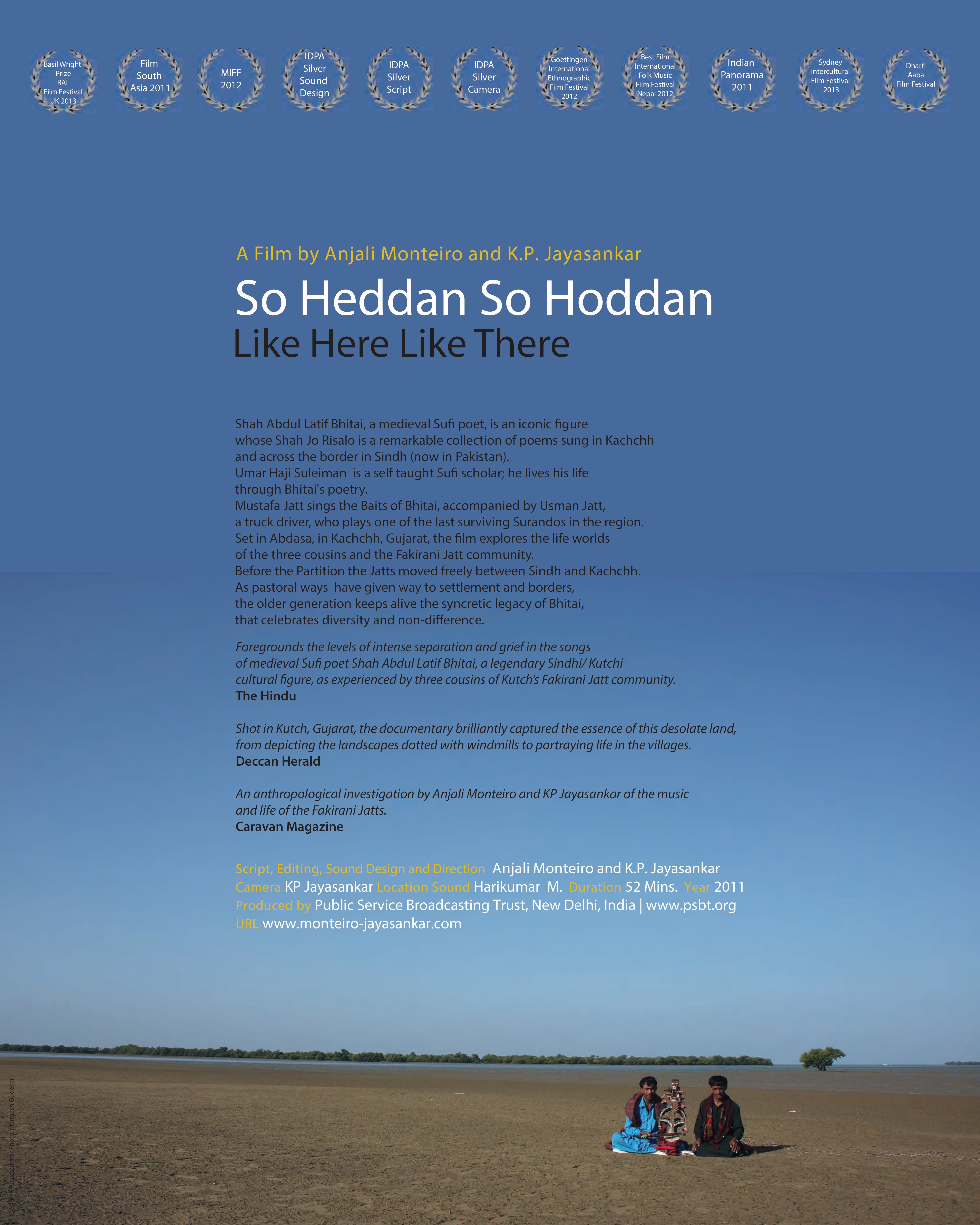
So Heddan So Hoddan (Like Here Like There)
52 mins, 2011, PSBT
Directed by Anjali Monteiro and KP Jayasankar
Synopsis
Shah Abdul Latif Bhitai, a medieval Sufi poet, is an iconic figure in the cultural history of Sindh. Bhitai’s /Shah Ji Risalo/ is a remarkable collection of poems which are sung by many communities in Kachchh and across the border in Sindh (now in Pakistan). Many of the poems draw on the eternal love stories of /Umar-Marui/ and /Sasui-Punhu/, among others.
These songs speak of the pain of parting, of the inevitability of loss and of deep grief that
takes one to unknown and mysterious terrains.
Umar Haji Suleiman of Abdasa, in Kachchh, Gujarat, is a self-taught Sufi scholar; once a cattle herder, now a farmer, he lives his life through the poetry of Bhitai. Umar’s cousin, Mustafa Jatt sings the Beths of Bhitai. He is accompanied on the Surando, by his cousin Usman Jatt. Usman is a truck driver, who owns and plays one of the last surviving
Surandos in the region. The Surando is a peacock-shaped, five-stringed instrument from Sindh. The film explores the life worlds of the three cousins, their families and the Fakirani Jat community to which they belong.
Before the Partition the Maldhari (pastoralist) Jatts moved freely across the Rann, between Sindh (now in Pakistan) and Kutch. As pastoral ways of living have given way to settlement, borders and industrialisation, the older generation struggles to keep alive the rich syncretic legacy of Shah Bhitai, that celebrates diversity and non-difference, suffering and transcendence, transience and survival. These marginal visions of negotiating difference in creative ways resist cultural politics based on tight notions of nation-state and national
culture; they open up the windows of India’s national imaginary.
Awards
IDPA Silvers for Script, Sound Design, and Cinematography, 2011
Best Film, International Folk Film Festival, Kathmandu, 2012
Basil Wright Award, RAI International Festival of Ethnographic Film, 2013
Anjali Monteiro and K.P. Jayasankar
Anjali Monteiro and K.P. Jayasankar are former Professors from the School of Media and
Cultural Studies, Tata Institute of Social Sciences, Mumbai. They are involved in documentary production, media teaching and research. They have played a key role in setting up the School of Media and Cultural Studies, TISS and the MA and Ph.D. programmes in Media and Cultural Studies, which is a unique blend of theory and practice.
They have been commissioning editors and mentors for over 100 documentaries by students and early career filmmakers. They were awarded the Satish Bahadur Lifetime Achievement Award for Excellence in Film Education, by the National Institute of Design,
Ahmedabad in 2022.
Their documentary films, which have been screened across the world, have won 33 national and international awards. Their most recent award is a Commendation of the Jury for A Delicate Weave at the 16th RAI International Festival of Ethnographic Film, 2019. They were participating artists in the Kochi-Muziris Biennale, 2018, with their
installation based on their film Saacha (2001).
They write in the broad areas of censorship, documentary film and media and cultural
studies. Their book A Fly in the Curry (Sage, 2016), on independent Indian documentary, won a Special Mention for the best book on cinema at the National Film Awards, 2016.
They have also co-edited the books DigiNaka: Subaltern Politics and Digital Media in Post-
Capitalist India, (Orient Blackswan, 2020) and Many Voices, Many Worlds: Critical Perspectives on Community Media (Sage, 2021). They have been visiting faculty and fellows at several leading media and design institutions and lectured at universities across the world. They are both involved in campaigns against censorship and are associated with various media organisations. More about their work at http://www.monteiro-
jayasankar.com/
Screening followed by a Discussion with the filmmakers!
All are Welcome!
52 mins, 2011, PSBT
Directed by Anjali Monteiro and KP Jayasankar
Synopsis
Shah Abdul Latif Bhitai, a medieval Sufi poet, is an iconic figure in the cultural history of Sindh. Bhitai’s /Shah Ji Risalo/ is a remarkable collection of poems which are sung by many communities in Kachchh and across the border in Sindh (now in Pakistan). Many of the poems draw on the eternal love stories of /Umar-Marui/ and /Sasui-Punhu/, among others.
These songs speak of the pain of parting, of the inevitability of loss and of deep grief that
takes one to unknown and mysterious terrains.
Umar Haji Suleiman of Abdasa, in Kachchh, Gujarat, is a self-taught Sufi scholar; once a cattle herder, now a farmer, he lives his life through the poetry of Bhitai. Umar’s cousin, Mustafa Jatt sings the Beths of Bhitai. He is accompanied on the Surando, by his cousin Usman Jatt. Usman is a truck driver, who owns and plays one of the last surviving
Surandos in the region. The Surando is a peacock-shaped, five-stringed instrument from Sindh. The film explores the life worlds of the three cousins, their families and the Fakirani Jat community to which they belong.
Before the Partition the Maldhari (pastoralist) Jatts moved freely across the Rann, between Sindh (now in Pakistan) and Kutch. As pastoral ways of living have given way to settlement, borders and industrialisation, the older generation struggles to keep alive the rich syncretic legacy of Shah Bhitai, that celebrates diversity and non-difference, suffering and transcendence, transience and survival. These marginal visions of negotiating difference in creative ways resist cultural politics based on tight notions of nation-state and national
culture; they open up the windows of India’s national imaginary.
Awards
IDPA Silvers for Script, Sound Design, and Cinematography, 2011
Best Film, International Folk Film Festival, Kathmandu, 2012
Basil Wright Award, RAI International Festival of Ethnographic Film, 2013
Anjali Monteiro and K.P. Jayasankar
Anjali Monteiro and K.P. Jayasankar are former Professors from the School of Media and
Cultural Studies, Tata Institute of Social Sciences, Mumbai. They are involved in documentary production, media teaching and research. They have played a key role in setting up the School of Media and Cultural Studies, TISS and the MA and Ph.D. programmes in Media and Cultural Studies, which is a unique blend of theory and practice.
They have been commissioning editors and mentors for over 100 documentaries by students and early career filmmakers. They were awarded the Satish Bahadur Lifetime Achievement Award for Excellence in Film Education, by the National Institute of Design,
Ahmedabad in 2022.
Their documentary films, which have been screened across the world, have won 33 national and international awards. Their most recent award is a Commendation of the Jury for A Delicate Weave at the 16th RAI International Festival of Ethnographic Film, 2019. They were participating artists in the Kochi-Muziris Biennale, 2018, with their
installation based on their film Saacha (2001).
They write in the broad areas of censorship, documentary film and media and cultural
studies. Their book A Fly in the Curry (Sage, 2016), on independent Indian documentary, won a Special Mention for the best book on cinema at the National Film Awards, 2016.
They have also co-edited the books DigiNaka: Subaltern Politics and Digital Media in Post-
Capitalist India, (Orient Blackswan, 2020) and Many Voices, Many Worlds: Critical Perspectives on Community Media (Sage, 2021). They have been visiting faculty and fellows at several leading media and design institutions and lectured at universities across the world. They are both involved in campaigns against censorship and are associated with various media organisations. More about their work at http://www.monteiro-
jayasankar.com/
Screening followed by a Discussion with the filmmakers!
All are Welcome!